
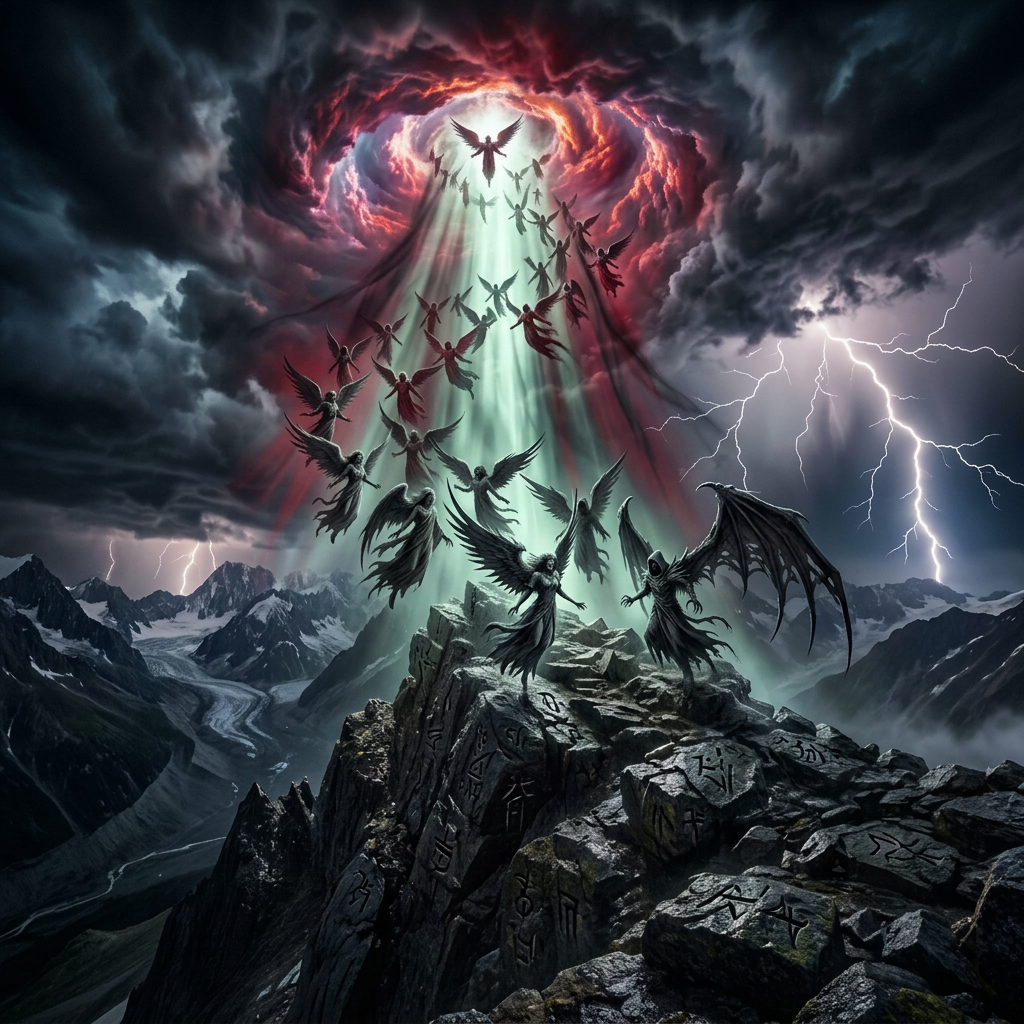
What happened when heavenly beings crossed the boundary between the spiritual and human realms? The story of the watchers in Genesis 6 answers with a story of heavenly rebellion. The sons of God took human women and produced the Nephilim. Their act opened the human world to a new kind of corruption.
The Watchers in Genesis 6 did not repeat the sin of Eden in the same way. Adam and Eve crossed a human boundary inside God’s sacred garden. The Watchers crossed a heavenly boundary and entered human life. Their rebellion brought spiritual power into a world already damaged by human sin.
The result was a second fall. Heavenly beings abandoned their appointed place, formed unlawful unions, and taught humans to use hidden power. Their giant offspring ruled through appetite and force. Genesis 6 describes a world where human evil and supernatural revolt began to work together.
More Than One Rebellion
Genesis 1–11 contains more than one rebellion. Each story involves a creature rejecting a place, task, or limit given by God. Eden begins the pattern when the first humans reach for wisdom on their own terms. Genesis 6 deepens the pattern when heavenly beings leave their own realm.
The wording in Genesis 3 and Genesis 6 links the two events. The woman saw that the tree was good, desired it, and took its fruit. The sons of God saw that human women were beautiful and took any women they chose. In both scenes, sight turns into desire, and desire turns into unlawful taking.
The rebels, however, move in opposite directions. Humans in Eden try to rise toward divine status. The sons of God descend toward human flesh. One rebellion reaches upward, while the other pushes downward into a realm the rebels were not appointed to rule.
These stories should be read together without being collapsed into one event. Eden corrupts the human calling from within. Genesis 6 adds rebellion from the heavenly side of creation. By the time the flood approaches, the earth has become the meeting place of both forms of revolt.
The same boundary-breaking pattern continues after Eden. Cain kills his brother and builds a city east of the garden. Lamech turns violence into a boast, while Babel later tries to reach heaven and make a great name. Genesis presents rebellion as a growing refusal to receive life, place, and power as gifts from God.
Eden Was a Sacred Mountain and Guarded Realm
Eden was more than a pleasant garden. It was the first sacred center where heaven and earth met. God walked there, humans served there, and the river of life flowed from there. The garden formed the pattern for later holy places in the Bible.
Genesis says a river flowed out of Eden and divided into four rivers. That image places Eden above the lands watered by those streams. Ezekiel later calls Eden “the holy mountain of God.” The BibleProject guide on mountains describes the cosmic mountain as “the place where Heaven and Earth meet.”
Adam’s work in Eden also had a priestly shape. He was told to work the garden and keep it. Those same Hebrew verbs later describe the work of priests who serve and guard the sanctuary. Adam was not only a farmer in a beautiful place; he was a guardian inside sacred space.
The garden had a guarded eastern entrance. After the human rebellion, God drove Adam and Eve out and placed cherubim at the way to the tree of life. Later sanctuaries also used cherubim, eastward entrances, and movement toward deeper holiness. Eden became the lost model behind the tabernacle, the temple, and the hope of restored creation.
Exile from Eden was a movement down and east. Cain moved farther east and built the first city named in Scripture. That movement showed more than distance on a map. It marked humanity’s growing distance from the presence, order, and life of God.
The sacred mountain of Eden helps define the second fall. Humans were driven out of the holy realm because they crossed a limit. The Watchers later came down from the heavenly realm because they rejected their own limit. Eden shows a holy union of heaven and earth under God, while Hermon becomes the site of a rival union formed through rebellion.
The Descent on Mount Hermon
Genesis calls the heavenly rebels “sons of God.” In Job, the same type of language refers to heavenly beings who appear before God or rejoice at creation. The phrase fits members of the heavenly court better than an ordinary human family line. Genesis 6 therefore describes a rebellion that begins above the human realm.
Genesis does not use the name Watchers for these beings. The Book of 1 Enoch supplies that title and expands the short biblical account. In 1 Enoch 6, the Watchers see human women and decide to take wives. Their desire becomes a planned mission rather than a private act.
Their leader fears that the others may abandon the plan and leave him to bear the punishment alone. The group answers by making a shared oath. The text says, “Let us all swear an oath.” Two hundred Watchers then descend on the summit of Mount Hermon.
The oath makes the rebellion corporate. These beings know they are crossing a forbidden line, and they bind themselves to complete the act together. Their descent is deliberate, organized, and sealed by a curse. They do not fall because of confusion or sudden weakness.
Mount Hermon becomes the landing place of an unlawful heavenly invasion. The region around Hermon and Bashan later carries strong links to giant clans, hostile spiritual powers, and the realm of the dead. The mountain stands near the northern edge of Israel’s world, where biblical geography often points toward danger and rival rule. The setting gives the descent a political as well as a spiritual meaning.
The offense was sexual because the Watchers took human women and produced offspring. It was also governmental because beings with heavenly rank claimed authority in a realm that was not theirs. Jude says they “did not keep within their proper domain” but left their own dwelling. Their marriages formed a rival order that joined spiritual power to human rule.
The scale of the judgment matches the scale of the act. The Watchers crossed the line between heaven and earth without God’s blessing. Their offspring embodied that corrupt union in visible form. The rebellion did not bring heaven to earth; it produced a counterfeit kingdom built on desire, force, and stolen authority.
The Forbidden Curriculum
The Watcher rebellion did not end with marriage and offspring. The rebels became teachers who gave humans access to forms of power. First Enoch 8 names weapons, metal work, spells, roots, celestial signs, cosmetics, jewels, and dyes. These lessons created a full curriculum for ruling bodies, nature, fate, desire, and status.
The created world was not evil. Metal, plants, stars, color, and beauty all belonged to God’s good creation. The corruption came from using knowledge outside a holy calling and apart from wisdom. The Watchers gave humans tools of rule without forming the character needed to use them well.
Weapons and Metallurgy
Azazel taught people to make “swords, and knives, and shields, and breastplates.” The list begins with tools designed for organized violence. Metal work could serve farming, building, and art, but the Watcher tradition puts weapons at the center. Knowledge that could support life was redirected toward control and bloodshed.
Weapons changed the scale of human anger. A violent person no longer needed equal strength to destroy another person. Armed rulers could control large groups through fear. Personal rage could become an army, a state, or a lasting system of oppression.
Genesis 4 already places metal work beside the growth of Cain’s city. Tubal-cain forged tools of bronze and iron, while Lamech boasted about killing a man. The text does not condemn craft or technology by itself. It shows that skill can grow quickly while the human heart grows proud and violent.
Sorcery, Roots, and Drug Knowledge
Other Watchers taught spells, root cutting, and the secret use of plants. Plants could heal wounds, feed families, and ease suffering. In the Enochic list, however, plant knowledge appears beside magic and manipulation. The aim shifts from caring for life to gaining hidden control over it.
This knowledge could be used to charm, curse, alter desire, or claim power over sickness and death. The teacher became a gatekeeper to forces that ordinary people could not see. Fear made that secret knowledge socially powerful. Those who controlled the remedy could also control the person seeking it.
The problem was not medicine. The problem was power separated from mercy, truth, and service. The Watcher curriculum turned creation into a set of forces to command. It encouraged humans to treat hidden knowledge as a path to mastery rather than a gift to use under God.
Astrology and Celestial Control
The Watchers also taught constellations, signs, clouds, the sun, and the course of the moon. Genesis presents the heavenly lights as markers for days and seasons. They reveal order and help humans live within time. Astrology changes those lights into a system for reading fate and seeking control.
A person who claims to read the sky can claim to know when rulers will rise, wars will begin, or fortunes will change. That claim gives the interpreter power over frightened people. It can shape marriages, battles, journeys, and public decisions. The heavens stop being signs of God’s order and become tools for human prediction.
The fallen teachers had once served within the heavenly order. They knew patterns that humans could only observe from below. Their rebellion turned knowledge of creation into a product for control. Wonder became technique, and worship became a search for leverage.
Adornment, Seduction, and Social Rule
Azazel also taught bracelets, ornaments, eye paint, precious stones, and colored dyes. Beauty itself was not the enemy. The danger came when beauty became a weapon for status, seduction, and ownership. Adornment could mark who possessed wealth, rank, access, or sexual power.
In a violent society, appearance can create social classes. Some people become objects to display, trade, desire, or possess. Others use luxury to signal that they stand above common limits. The body becomes another field where power is performed and enforced.
The four areas of teaching support one system of domination. Weapons control bodies, sorcery claims hidden forces, astrology claims fate, and adornment shapes desire and rank. Together they offer a way to rule the visible and invisible sides of life. The forbidden curriculum is power detached from wisdom, vocation, and love.
The Nephilim and the Corruption of Flesh
Genesis 6 places the Nephilim on the earth when the sons of God came to human women and had children by them. The Watcher reading treats these children as real hybrid offspring. They were giants born from an unlawful union of heavenly beings and human flesh. Genesis calls them mighty men and men of renown.
Ancient societies often celebrated mighty heroes who stood above ordinary people. Genesis places such figures near the collapse of the world. Their fame does not prove their goodness. Their power grows inside a story filled with violence, corruption, and divine grief.
First Enoch describes the giants as beings ruled by appetite. They consume the work and food of human communities. When those supplies fail, they turn against people and the rest of creation. Their hunger has no natural limit because their origin has already broken the created order.
The giants rule by taking. They consume because weaker people cannot stop them. They build fame through fear and make power look like greatness. Their enormous bodies reveal the spiritual shape of their society: appetite has become authority.
Genesis also describes corruption inside the human mind. Genesis 6:5 says every formation of the thoughts of the human heart was bent toward evil. The Hebrew word yetzer comes from a verb connected with forming or shaping. It points to the inner workshop where plans, images, designs, and purposes take form.
Human creativity was still active, but it was being aimed toward harm. The Watchers supplied new tools to people whose inner designs were already corrupt. Weapons, magic, celestial knowledge, and social display gave those designs greater reach. The crisis joined corrupted imagination to forbidden power.
The phrase “all flesh” also suggests that the damage had spread across the living world. Human violence affected families, cities, animals, land, and the structures of daily life. The giants intensified that damage through endless hunger and domination. The flood follows a crisis that is moral, physical, social, and supernatural at the same time.
Greek and Mesopotamian Echoes
The Watcher story shares patterns with other ancient traditions. Greek stories tell of Titans and culture-bringing figures such as Prometheus. Prometheus gives fire and crafts to humans and then receives divine punishment. The gift of power advances civilization while also creating conflict with heaven.
The biblical tradition treats that kind of gift with suspicion when it comes through rebellion. A higher being may offer knowledge that seems useful or glorious. The usefulness of the gift does not make the giver righteous. Power can improve human skill while making human violence more effective.
Mesopotamian traditions speak of the apkallu, ancient sages linked to the age before the flood. These sages brought writing, crafts, city plans, temple knowledge, law, and other arts of culture. They often appear as wise founders who helped establish civilization. Their memory could be honored by kings, priests, and scholars.
The Watcher account turns that praise upside down. Scholar Amar Annus argues that the story uses “inverted versions” of Mesopotamian beliefs about the apkallu. The same type of culture-bringing being can appear as a hero in one tradition and a criminal in another. First Enoch judges the teachers by the world their lessons produce.
Babylonian culture could honor ancient sages as builders of civilized life. The Enochic tradition answers that knowledge without obedience can corrupt civilization at its roots. Cities, crafts, weapons, ritual knowledge, and royal power can grow together. Their growth does not prove that the source was holy.
The story of Adapa carries another echo. Adapa is a wise sage from the ancient world who rises to heaven but refuses the food and water of life. He receives great wisdom but misses immortality. Wisdom and eternal life appear close together, yet the path between them is broken.
Genesis presents a related pattern in Eden. Humans seize wisdom and lose access to the tree of life. Adapa has wisdom but fails to receive the food of life, while the Watchers spread secret knowledge that produces death. These traditions preserve a shared fear that knowledge can be separated from faithful order and used against life.
Why the Watchers Receive No Restoration
The Watchers knew the heavenly order because they belonged to it. They understood their rank, their dwelling, and the limits of their authority. Their oath proves that they expected punishment and chose the act anyway. Greater knowledge gave their rebellion greater weight.
First Enoch presents the Watchers asking Enoch to carry their plea. They want relief from the sentence announced against them. The answer offers no path back to their former place. Their request cannot undo the women they took, the offspring they produced, or the knowledge they spread.
Jude connects their sin with leaving their appointed domain. It says God keeps these angels in darkness for the judgment of the great day. Second Peter says God did not spare the angels who sinned. The Greek wording uses the language of Tartarus for the place where they are held.
Tartarus was known in Greek thought as a deep prison for divine enemies. Peter uses that word to describe the fate of heavenly rebels. The Watchers came down from heaven to claim power on earth. God sends them farther down into confinement where their power can no longer spread.
Their prison reverses their crime. They crossed a boundary because they refused to remain in their appointed realm. God places them behind a boundary they cannot cross. The unlawful descent ends in a deeper descent under divine judgment.
Human beings throughout Genesis still receive commands, warnings, covenants, and calls to turn back. The Watchers receive chains because their act was a planned revolt by beings with direct knowledge of heaven’s order. They did not misuse a small gift in ignorance. They attacked the structure that defined their own place in creation.
A Doubly Fallen World
By Genesis 6, the earth carries two connected forms of rebellion. Humanity has been driven from Eden and now builds life outside the sacred garden. Heavenly rebels have entered that human world and added forbidden power to its violence. The earth becomes the contested ground between human sin and supernatural corruption.
Cain’s city provides the setting where this corruption can mature. A city gathers people, wealth, tools, trade, music, desire, and weapons into one place. None of those things must be evil. Each one, however, can increase the reach of a corrupt ruler or a violent culture.
Genesis 4 traces that growth through Cain’s family. Cain builds a city, Lamech takes two wives, Jabal develops herding wealth, Jubal develops music, and Tubal-cain develops metal craft. The same family line turns violence into public pride. Culture grows beside domination rather than curing it.
The Watchers enter a world already moving in that direction. Their lessons accelerate warfare, hidden control, social rank, and the use of desire as power. Their giant sons turn those lessons into rule by appetite. Violence now has teachers, tools, rulers, and institutions.
The flood story therefore begins with more than private wrongdoing. Human imagination has become fixed on evil, flesh has become corrupt, and the earth has filled with violence. Heavenly rebels have helped organize and enlarge that corruption. The crisis reaches the whole created order because both sides of the heaven-and-earth boundary have been violated.
Eden and Hermon mark two opposite ways that heaven and earth can meet. Eden joins the realms under God’s presence, wisdom, work, and limits. Hermon joins them through seizure, secret knowledge, and unlawful desire. The second fall creates a counterfeit union that makes a fallen human world far more destructive.
WATCH NEXT ON YOUTUBE
The Unseen Realm — documentary featuring Dr. Michael S. Heiser
The Satan and Demons Question and Response — BibleProject
The Satan and Demons — BibleProject
Who Were the Sons of God in Genesis 6? Enoch, Watchers, and Nephilim Explained
SOURCES AND NOTES
https://www.biblegateway.com/passage/?search=Genesis%206%3A1-4
1 Enoch 6, R. H. Charles translation, Wikisource
https://en.wikisource.org/wiki/The_Book_of_Enoch_(Charles)/Chapter_06
1 Enoch 8, R. H. Charles translation, Internet Sacred Text Archive
https://sacred-texts.com/bib/boe/boe011.htm
https://www.biblegateway.com/passage/?search=Jude%206-7&version=NET
2 Peter 2:4, Greek text and analysis
https://biblehub.com/text/2_peter/2-4.htm
The Symbolism of Mountains in the Bible, BibleProject
https://bibleproject.com/guides/the-mountain
Is the Garden of Eden on a Mountain?, BibleProject
https://bibleproject.com/podcasts/garden-eden-mountain
Amar Annus, “On the Origin of Watchers”
https://journals.sagepub.com/doi/10.1177/0951820710373978
Amar Annus, “The Story of the Watchers as a Counter Narrative”
https://www.mdpi.com/2077-1444/15/9/1024
The Myth of Adapa, World History Encyclopedia
https://www.worldhistory.org/article/216/the-myth-of-adapa

Leave a Reply