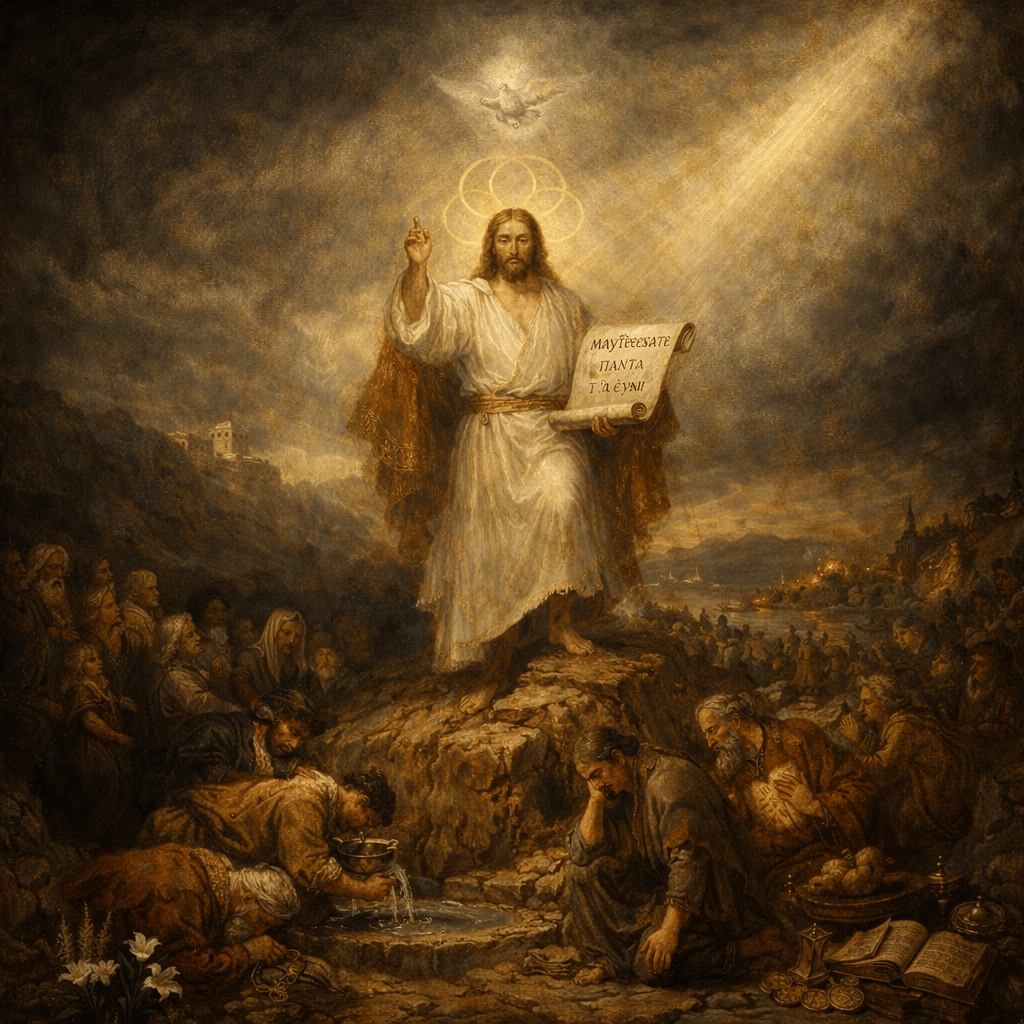
Matthew 28:16–20 is a royal charter issued by the enthroned Christ. But the next question presses: what kind of human community does a royal charter create? If the risen Jesus possesses “all authority in heaven and on earth,” then discipleship cannot remain a private spirituality or a set of detachable virtues. It is the long, sustained formation of persons into a shared and visible allegiance, an ordered way of life that can be recognized, tested, and, at times, contested in the world.
This is not to confuse the kingdom of God with any earthly regime. It is to take seriously the Bible’s own insistence that the reign of God creates a people whose life together is public, patterned, and accountable. The church is not only a gathering for worship; it is a commonwealth-in-exile, an embassy of the coming new creation, and therefore a community with practices, norms, discipline, and witness. To say “Jesus is Lord” is to locate the church within a civic grammar.
I. The Kingdom That Forms a People
Biblically, “kingdom” is not first a place but a rule: God’s active sovereignty made present and pressing in the person and work of Jesus. That rule is not only announced; it is enacted. In the Gospels, the kingdom comes with forgiveness, deliverance, healing, table fellowship, and the reordering of honor and status. When the King arrives, his reign produces a new social reality: the poor are blessed, the meek inherit, enemies are loved, and righteousness is redefined from performance to heart-level fidelity.
This is why discipleship is necessarily corporate. A king’s authority generates a polity; a king’s commands generate a shared way of life. The New Testament does not treat “obedience” as a solitary achievement but as a community’s practiced faithfulness: a people learning to speak truthfully, to reconcile, to steward possessions, to resist vengeance, to welcome the vulnerable, and to endure opposition without returning evil for evil. In other words, the kingdom takes shape as a public life.
II. The Canon as the Kingdom’s Constituting Archive
If discipleship is formation into a public allegiance, the Bible functions not merely as a collection of inspiring texts but as the church’s constituting archive, its chartered memory and normative instruction. The canon is architected to form a people over time.
Torah as ordered life under God’s kingship. The Pentateuch is not only theological; it is jurisprudential. It narrates deliverance, installs worship, and supplies the categories by which communal life is judged: holiness, justice, neighbor-love, integrity in speech, restraint in power, protection of the vulnerable, and limits on acquisitiveness. It forms Israel not merely as individuals of faith but as a visible society under Yahweh’s rule.
Prophets as covenant prosecutors and public diagnosticians. The prophets do not merely offer private comfort. They publicly audit the nation’s life, exposing the coherence between worship and ethics, between liturgy and economics, between claims of piety and the treatment of the poor. Their rhetoric assumes that the people’s life is visible and assessable. In prophetic logic, hidden injustice is not “someone else’s issue”; it is covenant betrayal.
Gospels as enthronement narratives and re-founding accounts. Each Gospel presents Jesus not only as teacher but as royal actor: authoritatively interpreting Torah, embodying the kingdom’s life, inaugurating a renewed people, and triumphing through cross and resurrection. The church is not formed by abstract principles but by a King’s life, death, and victory.
Epistles as governance for communities under Christ. The letters are not simply devotional reflections; they are administrative and pastoral instruments that order worship, discipline, leadership, moral formation, conflict resolution, and public credibility. They show the early church learning how to inhabit its identity as a people under a crucified and risen Lord.
Revelation as eschatological political disclosure. Revelation unveils the spiritual reality beneath imperial power, exposes idolatrous claims, and trains the church in patient fidelity. It ends not with escape but with the descent of a renewed world: the kingdom’s final public order in a restored creation.
Read this way, Scripture does not merely inform discipleship; it constitutes the people who practice it. The canon is the long-form pedagogy by which God forms citizens of his reign.
III. Liturgy as Naturalization Into a New Allegiance
If the canon constitutes the people, the church’s liturgy is where that constitution is repeatedly enacted. The church does not become public by adopting a political platform; it becomes public by practicing the kingdom’s life in worship that spills outward.
Gathered worship trains loyalties. In worship, the church rehearses the fundamental political claim of Christianity: ultimate authority belongs to Christ. Confession, praise, prayer, and proclamation are not merely interior exercises; they are allegiance-practices that relativize every rival sovereignty.
Prayer is civic formation. The Lord’s Prayer does not begin with self-management but with the sanctification of God’s name, the coming of God’s kingdom, and the doing of God’s will. It trains citizens to desire a divine public order and to ask for reconciliation and deliverance as realities with communal consequence. Prayer teaches a people what to love, what to hope for, and what kind of “peace” is worth seeking.
The Table is a social discipline. The Eucharist is never merely a private moment; it is a communal act with economic and relational implications. A shared meal under the Lordship of Christ forms a people who refuse humiliation, who learn to recognize one another as members of one body, and who treat fellowship not as sentiment but as practiced equity. The Table is an enacted critique of domination: it levels pride, rebukes contempt, and trains the church to embody a just communion.
In short: worship is not a retreat from public life. It is the church’s public rehearsal of the kingdom’s order.
IV. The Church as a Commonwealth in Exile
One reason modern readers struggle with the public nature of discipleship is that we have been trained to equate “public” with “partisan” and “political” with “state power.” The New Testament uses a different grammar. It describes the church as a people whose primary allegiance is elsewhere, and whose manner of life is therefore distinct within every earthly regime.
Peter names believers “sojourners” and “exiles,” calling them to honorable conduct “among the nations.” This is not escapism; it is visibility. The church’s identity is not hidden, and its life is meant to be legible. The goal is not self-protection but witness: a community whose goodness cannot be dismissed as private preference.
Paul likewise deploys citizenship language to describe a community whose primary commonwealth is “in heaven,” not in order to make believers indifferent to earthly life, but to establish a higher loyalty that reorders earthly conduct. The church becomes a disciplined society precisely because it belongs to Christ before it belongs to any nation.
This “diaspora” posture produces two stable commitments:
Respect without idolatry. The church honors legitimate authority and seeks peace, but refuses worshipful surrender to any regime’s ultimate claims. Distinctiveness without withdrawal. The church is present within the world, working, serving, building households, and seeking the good of neighbors, while maintaining a moral and liturgical nonconformity that marks it as Christ’s.
V. Discipleship as Civic Virtue by the Spirit
The New Testament’s moral vision is not primarily about cultivating admirable personalities; it is about producing a coherent people. The “fruit of the Spirit” is therefore not a private ornament. It is the Spirit’s social architecture: love, joy, peace, patience, kindness, goodness, faithfulness, gentleness, and self-control, as the shared virtues that make a community durable, non-anxious, and credible.
This is why the apostolic writings repeatedly bind spiritual maturity to communal practices: refusing partiality, repairing conflict, bearing burdens, guarding speech, honoring the weak, practicing generosity, and resisting the corrosive vices that disintegrate communal trust. Discipleship is Spirit-enabled habituation into the kingdom’s public life.
Importantly, this virtue is not abstract. It is tested in concrete pressures: scarcity, insult, injustice, power, sexuality, money, and status. A people formed by the Spirit learns to respond to these pressures in ways that are socially intelligible and morally striking, precisely because their loyalty is anchored in the Lordship of Christ rather than in fear, appetite, or tribal animus.
VI. Vocation as Embassy and Public Good
A kingdom people must also learn how to inhabit ordinary work and civic life without either baptizing the world’s values or retreating into irrelevance. The New Testament’s posture is neither domination nor disappearance. It is faithful presence under a higher King.
Work is treated as a site of neighbor-love: a means to provide, to share, to practice integrity, and to earn credibility “before outsiders.” Public good is not an optional add-on; it is a natural fruit of regeneration. The church’s life together is meant to spill outward as mercy, stability, and service.
At the same time, the church’s embassy posture sets limits. When authorities demand ultimate allegiance, that is, when they claim what belongs to God, the church must refuse. This refusal is not anarchy; it is ordered fidelity. The church can honor laws, pay taxes, and participate constructively while maintaining that worship belongs to God alone.
The prophetic and apocalyptic texts sharpen this point: regimes can become beastly when they absolutize themselves. Discipleship therefore includes political discernment, not to create a “Christian state,” but to keep the church’s worship pure and its witness uncoerced.
Conclusion
In Matthew 28, the King speaks, and discipleship begins. And so, A King with universal authority necessarily creates a people with a visible way of life. The canon forms that people across time; worship enacts their allegiance; the Spirit supplies their civic virtues; and vocation becomes embassy work for the good of neighbors.
In this frame, “discipleship” is not reduced to personal improvement or doctrinal literacy, though it includes both. It is the sustained instruction of persons into a shared, public identity: citizens of Christ’s reign who learn, together, how to live as a kingdom people in the midst of the nations, until the day when the King’s authority, already true, becomes universally acknowledged.
 Fresh Ground Theology
Leave a comment