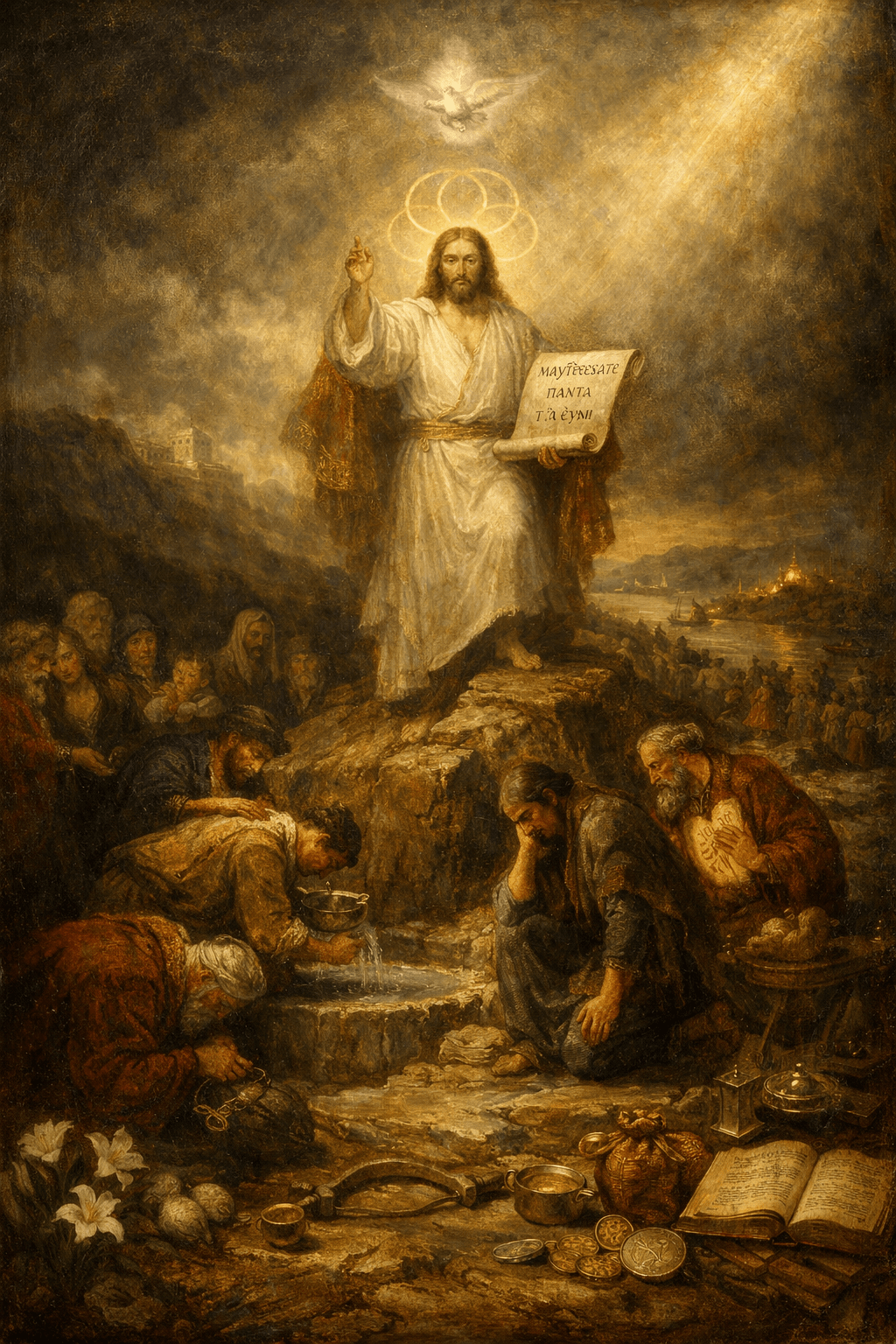
Matthew closes his Gospel not with epilogue but with enthronement. On a mountain in Galilee, the risen Jesus declares, “All authority in heaven and on earth has been given to me” (Matt 28:18). He then commissions the Eleven: “Go therefore and make disciples of all nations… teaching them to observe all that I have commanded you… and behold, I am with you always” (Matt 28:19–20). These lines are a royal charter. What follows offers an exegetical theology of the Great Commission that foregrounds Christ’s ascension-enthronement, the worshipful (and hesitant) response of the disciples, the covenantal scope of “teaching them to observe,” and the holistic, culture-forming reach of Jesus’ commands.
I. The Enthronement of the Son
Though Matthew does not narrate the visible ascent (Luke 24:51; Acts 1:9), he proclaims the result of the ascension: universal dominion. The divine passive, “has been given to me” (Matt 28:18), signals the Father’s bestowal of kingship upon the Son. This is the narrative fulfillment of the Davidic and apocalyptic hopes.
Davidic Son installed in power. Paul frames the Gospel as concerning God’s Son, “descended from David according to the flesh and declared to be the Son of God in power… by his resurrection” (Rom 1:3–4). The resurrection is not merely vindication; it is royal installation. The promise to David was, “I will establish the throne of his kingdom forever” (2 Sam 7:13), and “I will be to him a father, and he shall be to me a son” (2 Sam 7:14). Psalm 2 celebrates that installation: “I have set my King on Zion” and “You are my Son” (Ps 2:6–7). Matthew’s closing scene announces that this promised Son now reigns not only over Israel, but over “all nations” (Matt 28:19).
Danielic Son of Man given dominion. The language of worldwide authority evokes Daniel’s vision: “one like a son of man… to him was given dominion and glory and a kingdom, that all peoples, nations, and languages should serve him” (Dan 7:13–14). Jesus has repeatedly identified himself as the Son of Man throughout Matthew (e.g., Matt 26:64), and here the Father’s gift of “all authority” makes explicit that Daniel 7 has arrived.
Exaltation to God’s right hand. Other apostolic witnesses interpret the resurrection-ascension as session: God “seated him at his right hand… far above all rule” (Eph 1:20–21); the Son “sat down at the right hand of the Majesty on high” (Heb 1:3); “God has highly exalted him” so that “every knee should bow” (Phil 2:9–10). Psalm 110’s oracle (“Sit at my right hand,” Ps 110:1) undergirds this royal theology and is a key messianic text in Matthew’s Gospel (cf. Matt 22:44).
Implication for Matthew 28. Read in this canonical frame, “All authority… has been given to me” (Matt 28:18) is an enthronement formula. The Great Commission is therefore not a mere programmatic strategy for outreach; it is the royal decree of the enthroned Son, the Davidic Messiah and Danielic Son of Man, now invested with universal sovereignty.
II. Bowing Before the King
Matthew notes the mixed response: “When they saw him they worshiped him, but some doubted” (Matt 28:17). Two terms are crucial.
“They worshiped”: royal homage. The verb is proskyneō, “to bow down, to prostrate oneself, to worship.” It is used of homage rendered to a king (cf. the Magi who “fell down and worshiped him,” Matt 2:11) and of reverence to Jesus throughout Matthew (e.g., 14:33; 28:9). In 28:9 the women “took hold of his feet and worshiped him,” an act of bodily prostration before a sovereign. Against this backdrop, the disciples’ posture in 28:17 is enthronement-consistent: the proper human response to the exalted Lord is to bow.
“Some doubted”: hesitation to kneel. The verb is distazō, used earlier when Peter, seeing the wind, began to sink and Jesus asked, “Why did you doubt?” (Matt 14:31). The sense is hesitation, wavering, likely reluctance to render full allegiance. In a royal scene, “doubt” is not merely cognitive uncertainty; it is fealty delayed. The enthroned Christ elicits either prostration or pause. This tension is pastorally realistic: even eyewitnesses can waver in the decisive moment of homage.
Kingdom significance. Matthew’s Gospel has prepared us for this polarity. Jesus’ authority provokes worship (Matt 8:2; 9:18; 15:25) and scandal (13:57). The same King whose word calms seas (8:26–27) and forgives sins (9:6) demands a decisive allegiance that touches the body (“every knee should bow,” Phil 2:10) and the will (“follow me,” Matt 16:24). The Great Commission scene is thus an enthronement audience: some bend the knee; others hesitate on the threshold.
III. The Kingdom Frame
Imperative and means. The main verb is the aorist imperative matheteusate: “make disciples” (Matt 28:19). The participles specify the means: “going,” “baptizing,” and “teaching” (poreuthentes… baptizontes… didaskontes). The mission is not merely to secure decisions but to cultivate lifelong learners and loyal subjects of the King.
Universal scope: “all nations.” The object is panta ta ethnē (every people group, Matt 28:19). This fulfills Abrahamic and Davidic trajectories: through the seed, the nations are blessed (Gen 22:18), and the royal Son receives the ends of the earth as inheritance (Ps 2:8). Matthew’s Gospel has hinted at this universal horizon from the Magi (Matt 2:1–12) to the centurion (8:10–11) and Jesus’ prophecy that the Gospel will be preached “in the whole world” (24:14).
Baptism and allegiance. Disciples are to be baptized “into the name of the Father and of the Son and of the Holy Spirit” (Matt 28:19). The singular “name” (one name, three persons) underscores Trinitarian unity. To be baptized “into the name” (eis to onoma) is covenantal transfer of ownership and allegiance, much like swearing fealty in a royal court (cf. Rom 6:3–4). It is initiation into the King’s people.
Teaching obedience in a kingdom key. The commission is not “teach them information,” but “teaching them to observe (tērein) all that I have commanded you” (Matt 28:20). Tēreō means to keep, guard, obey (cf. John 14:15). The curriculum is “all I have commanded,” and the standard is observance. This is kingship language: a sovereign’s decrees are to be kept. Consequently, discipleship is essentially covenant obedience lived under Christ’s royal authority.
Presence as royal assurance. The King adds the covenant promise: “I am with you always, to the end of the age” (Matt 28:20). This echoes “Immanuel… God with us” (Matt 1:23) and assures that the enthroned Christ accompanies his emissaries. The royal commission is resourced by royal presence.
IV. The Law Written on the Heart
If the Great Commission mandates obedience to Christ’s commands, the New Covenant provides the power and interiority to live them.
Jeremiah’s promise. “I will make a new covenant… I will put my law within them, and I will write it on their hearts” (Jer 31:31, 33). The locus of the law shifts from tablets to hearts; obedience becomes internalized.
Ezekiel’s complement. God promises, “I will give you a new heart… and I will put my Spirit within you, and cause you to walk in my statutes” (Ezek 36:26–27). The Spirit effects what the law requires.
Apostolic exposition. Paul contrasts the Mosaic and New Covenants: “the letter kills, but the Spirit gives life” (2 Cor 3:6). The New Covenant is the “ministry of the Spirit” with greater glory (2 Cor 3:8), and those beholding the Lord are “being transformed… from one degree of glory to another” (2 Cor 3:18). Hebrews cites Jeremiah to insist that in Christ, God’s law is “on their hearts” (Heb 8:10; 10:16).
Integration with the Commission. The command to teach obedience (Matt 28:20) presumes the New Covenant gift that enables obedience. The enthroned Christ rules a people upon whose hearts his torah is inscribed, by his Spirit. Discipleship is therefore not mere moralism; it is Spirit-enabled conformity to the King. The Commission is a New Covenant charter.
V. The Culture of the Kingdom
Jesus’ commands are not a narrow ethics elective; they constitute a public way of life. The Sermon on the Mount alone addresses worship, economics, conflict, sexuality, speech, anxiety, piety, and social witness, forming a kingdom culture. Consider representative domains.
Moral integrity and inner transformation. Jesus radicalizes righteousness: “Everyone who looks at a woman with lust has already committed adultery” (Matt 5:28); “Do not swear at all… let what you say be simply ‘Yes’ or ‘No’” (Matt 5:34, 37); “Love your enemies and pray for those who persecute you” (Matt 5:44). These commands reach motives, not only behaviors, modeling the New Covenant’s inward law. Economic life: treasure, generosity, stewardship, and investing. • Treasure and allegiance. “Do not lay up for yourselves treasures on earth” (Matt 6:19). “Where your treasure is, there your heart will be also” (Matt 6:21). Kingdom economics begins with reordered desires. • Generosity as norm. “When you give to the needy” (Matt 6:2) assumes habitual almsgiving. Jesus commends secret, sincere generosity (6:3–4). • Anxiety and provision. “Do not be anxious… your heavenly Father knows that you need them all” (Matt 6:31–32). The antidote is vocational priority: “Seek first the kingdom… and all these things will be added to you” (Matt 6:33). • Stewardship and investment. In the Parable of the Talents, faithful servants deploy entrusted capital and are praised: “You have been faithful over a little; I will set you over much” (Matt 25:21). The problem is not fruitfulness through enterprise, but slothful fear (25:24–27). Kingdom discipleship dignifies wise, risk-aware stewardship under the King. Vocational and civic responsibility. “Render to Caesar the things that are Caesar’s, and to God the things that are God’s” (Matt 22:21). Jesus forms citizens who honor lawful authority without idolatry, maintaining ultimate allegiance to God’s image and name. Conflict, reconciliation, and institutional health. “First be reconciled to your brother” (Matt 5:24). In community discipline: “If your brother sins against you, go and tell him his fault… if he listens… you have gained your brother” (Matt 18:15). Procedures for witnesses and church admonition (18:16–17) sketch governance for a holy people under Christ’s keys (cf. 16:19). Obedience forms durable institutions of truth and mercy. Emotional health and spiritual practices. • Anxiety, fear, and trust. “Do not be anxious about your life” (Matt 6:25). The command is accompanied by a re-visioning of the Father’s care for “birds of the air” and “lilies of the field” (6:26–29). • Prayer, fasting, secrecy, and the heart. “When you pray… go into your room” (Matt 6:6). “When you fast, anoint your head” (Matt 6:17–18). The Lord’s Prayer orders desire: “Your kingdom come, your will be done” (Matt 6:10). • Rest in the King. “Come to me… and I will give you rest” (Matt 11:28). Royal yoke is restorative: “My yoke is easy, and my burden is light” (Matt 11:30). Family, sexuality, and covenant fidelity. Jesus roots marriage in creation: “The two shall become one flesh” (Matt 19:5). He condemns lust (Matt 5:28), calls for reconciliation over rupture (5:23–24), and upholds covenant seriousness (5:31–32; 19:6). Obedience shapes households as micro-polities of the kingdom. Justice, mercy, and public righteousness. Jesus rebukes tithing that neglects “the weightier matters of the law: justice and mercy and faithfulness” (Matt 23:23). Kingdom culture values both generosity and structural righteousness. Social witness and public plausibility. “You are the salt of the earth… the light of the world” (Matt 5:13–14). “Let your light shine… so that they may see your good works and give glory to your Father” (Matt 5:16). The King’s people are a visible polis, a city on a hill.
Synthesis. The Commission’s “teaching them to observe all that I have commanded” (Matt 28:20) necessarily entails forming a way of life that is comprehensive: moral, economic, vocational, relational, emotional, and institutional. Jesus’ commands are not “Sunday-only”; they construct a culture under the authority of the enthroned King.
VI. The Church’s Whole-Person Task
Discipleship defined. To be a disciple is to apprentice one’s entire self to Jesus: mind, loves, habits, assets, and relationships. The Commission does not target mere cognition (“teach them that I commanded”) but action (“teach them to observe”). This is the obedience of faith (cf. Rom 1:5) appropriate to a King whose authority spans “heaven and earth” (Matt 28:18).
Church as royal pedagogy. The local church, therefore, is an embassy of the kingdom, charged to baptize into the Triune Name (Matt 28:19) and to catechize the whole person in the whole counsel of Christ (28:20). Its ministries must embrace worship and work, doctrine and discipline, mercy and mission. The church teaches people to pray (Matt 6:9), to reconcile (Matt 5:24; 18:15), to steward and give (Matt 6:2; 25:21), to witness publicly as salt and light (Matt 5:13–16), to honor authorities without idolatry (Matt 22:21), to keep marital covenants (Matt 19:6), to reject anxiety and practice trust (Matt 6:25–34), and to endure in hope under the King’s promise, “I am with you always” (Matt 28:20).
New Covenant power for New Covenant obedience. Because the law is written on hearts (Jer 31:33) and the Spirit causes us to walk in God’s statutes (Ezek 36:27), the church forms disciples not by external compulsion but by internal transformation: “the Spirit gives life” (2 Cor 3:6), and beholding the Lord we “are being transformed” (2 Cor 3:18). This inner renovation enables the wide-ranging obedience that Jesus commands.
Conclusion
Matthew 28 is the enthronement proclamation of the crucified and risen Son of David, now “declared… Son of God in power” (Rom 1:4). In that light, the Great Commission is the King’s own decree: make disciples of every nation, baptizing them into the Triune Name, and teaching them to obey everything he commands (Matt 28:19–20). The disciples’ mixed response (some bowing, others wavering, Matt 28:17) alerts us that allegiance is the issue: enthronement summons worship.
Because this is a New Covenant charter, the commands of Christ are written on the heart (Jer 31:33), empowered by the Spirit (Ezek 36:27; 2 Cor 3:6), and extend to every facet of life: moral integrity (Matt 5–7), economic stewardship (Matt 6; 25), civic responsibility (Matt 22:21), institutional health and reconciliation (Matt 18), emotional trust (Matt 6:25–34), family fidelity (Matt 19), justice and mercy (Matt 23:23), and public witness (Matt 5:13–16). The church, as a kingdom embassy, must therefore aim at whole-person formation under the reign of Christ.
If Jesus truly possesses “all authority in heaven and on earth” (Matt 28:18), then discipleship cannot be piecemeal. It is comprehensive allegiance encompassing mind and body, private and public, worship and work, lived in obedience to the King who promises, “I am with you always, to the end of the age” (Matt 28:20).
 Fresh Ground Theology
Leave a comment