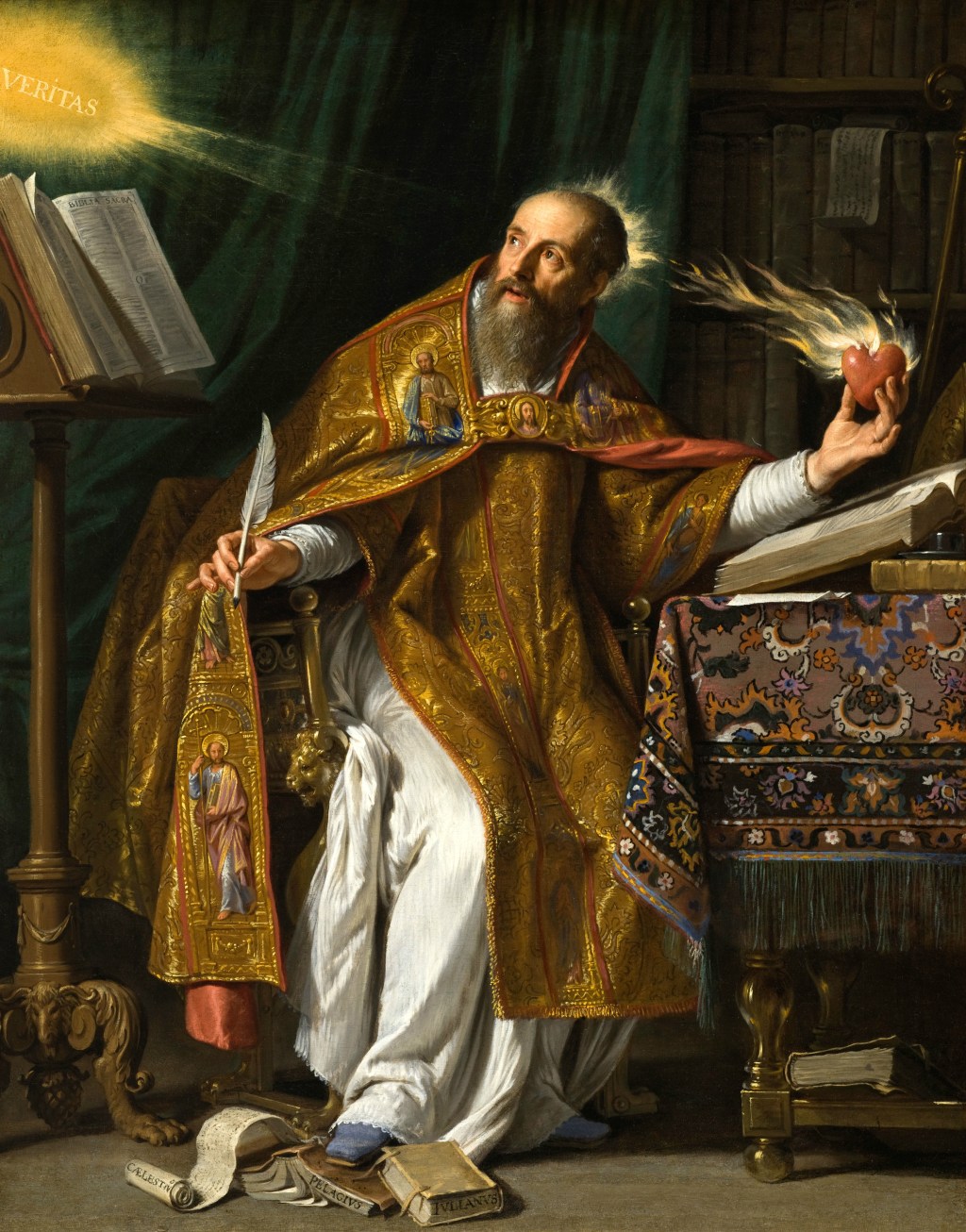
Augustine does not end On Christian Doctrine with a flourish. He ends with a commission. Having summoned the preacher to love God more than words, to read Scripture as more than text, he now turns—carefully, compellingly—to the twin matters that make proclamation possible: metaphor and eloquence. One clarifies meaning; the other gives it wings.
In Book III, Augustine moves from the realm of signs and interpretation to the thorny terrain of figurative language. Scripture, he insists, speaks with many voices. And not all of them say what they seem.
Book III: On Figuration and Misreading
Some ambiguities, Augustine concedes, are simply technical. A misplaced punctuation mark or a shift in pronunciation can change the meaning of a sentence entirely. In such cases, the interpreter must rely on the rule of faith—the great doctrinal tradition of the Church—and consult the wider context of Scripture. Where clarity remains elusive, the preacher is permitted to choose the meaning most aligned with faith, reason, and love. It is, Augustine admits, an interpretive act that requires both boldness and humility.
But textual ambiguity is only the beginning. The greater danger lies in the twin errors of reading literal statements figuratively and figurative statements literally. Here, Augustine is at his most incisive.
To read everything literally is to become enslaved to signs, mistaking the symbol for the thing it signifies. The Jews, he argues, erred in this way—clinging to the letter of the law while missing the grace to which it pointed. The Gentiles, too, bound themselves to idols, confusing the creature for the Creator. In Christ, both errors are overcome. The veil is lifted. The signs are fulfilled.
But the opposite mistake is just as perilous: assuming that everything is allegory, that every concrete detail masks a hidden spiritual truth. Augustine offers guidelines. If a passage promotes virtue and sound doctrine, take it at face value. If it appears to promote vice, interpret it figuratively. Commands that seem immoral must be symbolic. Stories of ancient patriarchs—such as David’s many wives—should be read in light of historical context, not moral prescription.
There is a deep pastoral caution here. Scripture, Augustine reminds us, contains not only revelation but accommodation—divine wisdom meeting human weakness in real time. What was permitted then may be forbidden now. What was descriptive then may be figurative for us. The interpreter must hold the tension without collapsing it into a single reading.
He closes Book III with a nod to Tichonius, a Donatist theologian whose seven interpretive rules Augustine appropriates with surprising generosity. Scripture, Tichonius noted, often shifts between speaking of Christ and His Church, mixes references to true believers and false ones, contrasts law and grace, and recapitulates earlier moments in salvation history without warning. It also moves fluidly between the body of Christ and the body of Satan—between the saints and the damned—often within the same breath.
Augustine does not endorse Donatism. But he does honor its insights. Truth, it seems, can shimmer even when held by flawed hands.
Book IV: Teaching with Fire and Light
Having laid the foundation for a faithful reading of Scripture, Augustine turns in Book IV to the delivery of that reading—to rhetoric, that old art of persuasion. But he does so with a careful distinction: the preacher is not a sophist, nor a showman. His aim is not applause but obedience. He teaches not for vanity, but for love.
It is not that eloquence is unimportant. It is that eloquence must be wedded to wisdom. Augustine admits he never studied the classical schools of rhetoric himself. Instead, he listened. He read. He practiced. And he urges the same of Christian teachers.
Words, he says, must not only inform but move. “To teach, to delight, and to sway”—these are the three duties of sacred speech. But of these, clarity is paramount. Better a plain truth than an ornate falsehood. Better a dry explanation than a dazzling distraction. The teacher must discern not only what to say, but when and how to say it. Difficult doctrines should often be reserved for private instruction. The pulpit is for truth, not puzzles.
Still, when truth is clear, it must sometimes come clothed in power. Augustine acknowledges the full range of styles available to the preacher: subdued, temperate, majestic, even tearful. He names his heroes—Ambrose, Cyprian—and commends their cadence. But he cautions against performance. Eloquence, for the preacher, is never the point. The point is transformation.
The majestic style, when used well, can bring a man to his knees. The quiet style can persuade the skeptic. The temperate style can steady the heart. But each must serve love. The preacher’s voice must be an echo of the divine Word: piercing, tender, unshakably true.
And behind the voice must stand the life. No rhetorical flourish can substitute for integrity. No clever argument can conceal a hollow soul. The preacher must live what he speaks, or his words will be nothing more than wind.
Augustine’s Gift to Preachers
When the final lines of On Christian Doctrine fade, one is left not with formulas but with a portrait—a preacher who is part scholar, part lover, part midwife of grace. Augustine has not merely given us a method. He has given us a way of being.
His legacy in this work is fivefold.
First, he grounds all interpretation in love. The preacher must be a man consumed with the enjoyment of God. Before he speaks, he must adore. Before he teaches others, he must be taught by delight.
Second, he insists on mastery of Scripture. The whole canon must be familiar. The shape of redemptive history must live in the preacher’s bones. Only then can he distinguish the clear from the obscure, the essential from the peripheral.
Third, he dares to commend pagan knowledge. The sciences, the arts, the disciplines of the world—these too are gifts, to be plundered like Egypt’s gold, refined, and returned in service to the Kingdom. But he cautions against contamination. The tools of the world must be purified, not baptized blindly. Christian teachers must discern the presuppositions embedded in secular systems—and either reshape them or discard them.
Fourth, his treatment of figurative language is perceptive, if at times overly restrictive. Augustine’s inclination is to tether every passage to piety, to judge its meaning by its ethical utility. This yields spiritual depth, but may miss historical texture. Not every genealogy is a metaphor. Not every divine judgment is a parable. Scripture is not merely moral instruction; it is also the record of what God has done in time.
And fifth, Augustine’s reflections on rhetoric remain timeless. His insistence on clarity is especially poignant. In a world of noise and novelty, where sermons can drift into TED Talks or moral platitudes, Augustine calls us back to the sacred craft of teaching with fire and light. Clarity, he says, is not the enemy of beauty. It is the soul of it.
A Closing Benediction
On Christian Doctrine is not a manual in the modern sense. It is not a checklist, nor a curriculum. It is more like a pilgrimage. One begins in the love of God, walks through the thickets of signs and language, and emerges at last in the pulpit—trembling, luminous, ready.
Augustine does not promise mastery. He does not pretend that the sacred task is easy. But he does offer a vision: of a teacher who loves what he says, knows what he says, and says it in a way that helps others love and know the same.
This, he believed, is how the Church will endure. Not by force, not by spectacle, but by faithful men and women who speak the truth—clearly, beautifully, and with love.
And that, even now, is doctrine worth teaching.
 Fresh Ground Theology
Leave a comment